October 29, 2026
ADA Mobile Toilet Requirements Every Rental Coordinator Ought To Testimonial
By @stepheneypa065
If you have ever before been accountable for toilet preparation at an occasion, short-lived worksite, public celebration, or seasonal operation, you currently understand how quick portable sanitation decisions can become demanding. The stress usually lands at one time. Head count adjustments. The website shifts. A delivery van needs a different entryway. Then someone asks the inquiry that must have been settled much previously: do we have the appropriate easily accessible device, in the appropriate area, set up the appropriate way?
That inquiry matters far past logistics. An ada mobile toilet is not simply another line item on a rental order. It becomes part of whether visitors, employees, attendees, and members of the public can make use of the website with self-respect and independence. When coordinators deal with accessibility as a last-minute add-on, they commonly end up with a pricey scramble and a setup that still drops short.
The excellent news is that the core demands are not mystical. They do, nonetheless, should have mindful evaluation. A compliant order has to do with greater than requesting one bigger system. Positioning, route, entrance conditions, recognition, and the variety of easily accessible units in a cluster all issue. Those information are where rental strategies normally are successful or fail.
The requirement that gets missed out on most often
The point I see forgotten most often is simple: when portable single-user commode units are given in a collection, a minimum of 5 percent of the systems because collection need to come. That standard uses even at temporary events.
That captures people off-guard because short-lived setups usually get treated as casual. An organizer may think a weekend celebration, a short-term activation, or a pop-up procedures website has looser expectations than a long-term center. It does not function in this way. Momentary does not mean exempt. If you are bringing in a financial institution of single-user mobile commodes for public use, the available matter has to be part of the initial calculation.
This is where a lot of little preparation blunders begin. A person approximates 8 typical systems, then later tacks on one ada easily accessible portable restroom due to the fact that it feels prudent. Often that winds up pleasing the 5 percent minimum. Sometimes the mathematics changes when the order grows. If the cluster broadens and no one reviews the obtainable count, the website can drift out of conformity without any individual seeing up until delivery day.
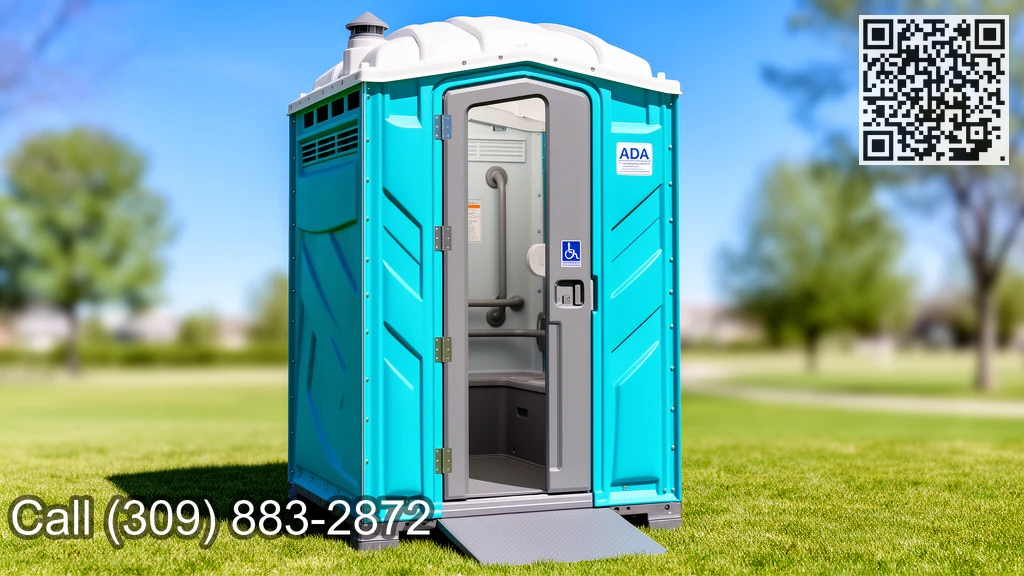
The far better routine is to compute availability whenever the quantity changes. It appears noticeable, however on hectic projects, the washroom matter is among the most frequently revised numbers on the page.
"Available" is not almost device size
A bigger cabin alone does not automatically please the ADA criteria. This is the second mistake that rental planners make under timetable stress. They buy what is described in laid-back sales language as a handicap system, a mobility device unit, or a bigger trailer stall, and think that is enough.
What really matters is whether the ada compliant portable toilet or ada portable restroom meets the applicable technical needs. The federal standards require accessible mobile toilet systems to fulfill toilet-room technological requirements, including clearances, turning area, and door maneuvering clearances, along with applicable rules for grab bars and water-closet clearances. The system needs to also have an obtainable entry and be reached by an easily accessible course. If ramps or touchdowns are required, those attributes should abide by ADA technological requirements as well.
That suggests ease of access is about the whole customer experience from strategy to leave. A device can be marketed as an ada certified obtainable portable restroom, yet if it is gone down on a spot of ground that a mobility device customer can not fairly get to, the configuration still has an issue. The same holds true if the entryway area is blocked, unstable, or set up in a manner that defeats the needed handling space.
This is where skilled organizers learn to quit assuming in terms of devices just. The rented out system matters, of course, however so does the site strategy around it.
The path to the device matters as long as the system itself
An easily accessible path is not an afterthought. It is just one of the core requirements, and on short-lived sites it is frequently the hardest part to obtain right.
Portable restrooms are often placed where vehicles can unload rapidly, where they run out the aesthetic center of an occasion, or where service accessibility is simplest. Those useful issues are actual. Any person who has actually managed toilet maintenance knows the worth of tidy vehicle accessibility and effective placement. But an area that helps servicing is not automatically obtainable for users.
A compliant ada portable bathroom rental setup has to take into consideration whether a person making use of a mobility device or other flexibility device can in fact reach the device and enter it. If the route crosses unequal ground, soft soil, a high modification in grade, or short-term obstacles, that can undermine the configuration. If a ramp or landing becomes part of the installation, it additionally has to follow the ADA technical rules.
That seems straightforward till weather condition obtains involved. I have seen flawlessly sensible site designs come to be pointless after a day of rainfall. Crushed rock changes. Lawn softens. Short-lived floor covering panels bend at their joints. None of that alters the access obligation. It just implies the planner must have expected site problems earlier and examined them once again before opening.
This is one reason final bathroom movings often tend to create difficulty. Moving the units to solve one problem frequently produces one more. A much better strategy is to walk the path from the customer's perspective prior to the last placement is approved.
Identification is not a minor detail
Accessible mobile bathroom devices should be identified with the International Symbol of Access. That need is very easy to please, but it is surprisingly very easy to neglect when orders are customized in a thrill or when units are swapped near to the distribution date.
The identification issues for a sensible reason. Individuals require to be able to discover the easily accessible device without thinking, without asking team, and without inspecting every door straight of mobile toilets. On a crowded website, clear recognition conserves time and reduces aggravation. It likewise indicates that accessibility was thought about intentionally, not improvised.
I have actually seen accessible units placed behind fencing runs, put too much from the remainder of the collection, or turned in a manner in which hides the recognizing icon from the main web traffic course. Also when the right system is practically existing, poor placement can make it functionally tough to situate. A coordinator who checks just the paperwork misses out on that reality.
Construction websites have a slim exception, and it ought to not be overread
There is a crucial subtlety in the standards that should have care. The ADA criteria differentiate mobile commode devices at building and construction sites that are utilized specifically by building workers. Those systems are excluded from the portable-toilet availability scoping need referenced in the 1991 standard.
That is a slim factor, and coordinators should be cautious with it. It does not get rid of accessibility requirements for basic mobile toilet services, and it ought to not be extended to cover scenarios it was not implied to cover. If the service is for broader public usage or for settings outside that special construction-personnel context, the accessible-unit need stays relevant.
This is a location where I typically see complication due to the fact that people listen to "construction website" and quit paying attention to the rest of the sentence. The exclusive-use aspect issues. So does the distinction between a crew-only setup and a site that serves visitors, customers, assessors, or the public. If an usage instance falls outside the narrow exemption, treating it as excluded can create unneeded lawful and functional risk.
Why momentary occasions are especially at risk to mistakes
Permanent structures generally have layers of evaluation. Drawings get checked. Facilities teams ask concerns. Accessibility issues are more probable to surface prior to opening up. Short-lived mobile toilet setups hardly ever get that level of analysis, even though the lawful requirements still apply.
Event preparation specifically often tends to compress choices into a brief timeline. A sponsor desires a footprint change. Food vendors require even more room. Parking shifts after license evaluation. Protection requests barriers. Somewhere because churn, the bathroom bank obtains pushed to an edge that looked fine on a map and verifies awkward on the ground.
That is why a lot of ada certified portable restrooms problems are not remarkable failures. They are build-ups of little oversights. The easily accessible system exists, however the course is bad. The count was correct on the very first variation of the order, however not after growth. The device satisfies the required technological concept, yet signs is not visible. Each problem looks minor in isolation. With each other, they leave customers https://daltongdqy647.northvaledigest.com/posts/ada-compliant-portable-restrooms-planning-rentals-with-availability-in-mind with an irritating or unusable setup.
An empathetic planner finds out to examine the setup with genuine people in mind, not just with a site diagram.
What a mindful evaluation need to cover prior to delivery
There is no requirement to turn toilet purchasing right into a legal seminar. Yet there does require to be a disciplined testimonial prior to the vehicles roll.
A beneficial pre-delivery check need to verify the following:
- The variety of obtainable systems in each cluster fulfills the 5 percent minimum for portable single-user toilets.
- The selected ada certified portable toilets are really meant to please ADA accessibility needs, not simply called bigger units.
- The route per available system is accessible, and the entryway condition sustains use.
- Any ramp or landing required for gain access to is being handled in such a way that follow ADA technological requirements.
- The accessible system will be understood the International Symbol of Accessibility and placed where customers can easily discover it.
That short evaluation catches a lot of the avoidable blunders I see in temporary washroom planning. It additionally helps different equipment issues from site issues. Vendors can offer an ada-compliant mobile toilet, however the coordinator still regulates where and how that system is installed.
Vendor discussions that are worth having early
Many rental troubles begin with vague language. A person requests a handicap device. Somebody else jots down "ADA bathroom." The order obtains processed, however the expectations remain unclear. Then the site group discovers too late that they never verified the route, the identification, or the number of obtainable devices were needed in the cluster.
A much better vendor discussion is direct. Ask especially for an ada certified portable toilet or ada-compliant portable restrooms appropriate for the intended usage, and after that chat via the site conditions. The factor is not to concern the vendor with every obligation. It is to ensure every person is solving the exact same problem.
In method, the toughest rental relationships are the ones where the consumer shares enough context. Is this a public occasion? A temporary procedures website? A collection near food solution? A vast website with multiple restroom banks? Those information shape how ease of access ought to be planned.
What you want to avoid is the all-too-common scenario where the easily accessible device gets here, practically feeds on the invoice, and still can not serve individuals well since nobody discussed the positioning realities.
The phrase "simply get one ADA unit" can lead you astray
That expression sounds efficient, however it can conceal numerous different mistakes.
First, one ada handicap available mobile restroom may not be enough if the collection size has actually grown. Second, "one ADA unit" states absolutely nothing regarding whether it will certainly be obtainable by an easily accessible path. Third, it does not address whether the device is effectively determined. Lastly, if there are several bathroom clusters on a site, focusing on one obtainable unit in one area can overlook the practical experience of users who may be no place near it when they need it.
This is a judgment problem more than a mathematical one. The standards give the framework, but real planning still needs thoughtful placement. A site can satisfy the minimum matter demand and still be frustrating if the available system is isolated or tough to reach from major activity zones.
That does not mean you invent added rules. It indicates you utilize common sense within the recognized requirements. Ease of access should be incorporated into the individual flow of the website, not dealt with like an afterthought tucked behind a tent line.
Broader enforcement fads are a reminder, not a distraction
Accessibility compliance is being applied in a wider environment across fields. Recent federal support task around electronic access for state and city government entities is a great reminder that ADA conformity is not dormant or symbolic. Different contexts have various target dates and technical problems, yet the larger message coincides: access commitments continue to be active and visible.
For rental coordinators, the lesson is not that portable toilet rules changed because of internet accessibility assistance. They did not. The lesson is that accessibility is entitled to sustained focus across operations, not occasional interest when an issue appears. Groups that recognize this tend to plan better in every short-lived setting, due to the fact that they quit dealing with ADA concerns as particular niche concerns.
I have discovered a sensible distinction in between companies that assume by doing this and those that do not. The first group asks availability questions throughout intending meetings. The second group asks them at delivery. By that point, choices are narrower and prices normally rise.
Common difficulty places on actual sites
Most accessibility failings in portable bathroom preparation are not rooted in bad intent. They originate from ordinary task friction, particularly when a number of suppliers and area groups are relocating quickly.
The trouble spots I enjoy most closely are these:
- A collection matter adjustments, however nobody recalculates the accessible-unit requirement.
- The available system is placed on a path that looks passable theoretically yet not in real site conditions.
- A device is classified casually as ADA-capable without confirming that it is suggested to satisfy applicable accessibility requirements.
- The recognizing ease of access icon is missing, blocked, or difficult to see from the major approach.
- The team focuses on distribution and servicing comfort while overlooking the actual user strategy and entry experience.
None of these issues are unique. They prevail, preventable, and pricey to deal with late.
A planner's mindset matters more than an ideal script
Every temporary site is a little bit various. A region fair has various restrictions than a road race. A public jobs presenting area varies from an outdoor wedding event location. That is why stiff scripts frequently stop working. Still, the ADA fundamentals for portable commodes continue to be steady enough that every planner must keep them close at hand.
Think in collections, not simply private units. Think in paths, not simply supply. Believe in user experience, not simply conformity wording. And when there is any kind of uncertainty about arrangement problems, solve it prior to the systems are placed.
This kind of care tends to turn up in little decisions. You assess the modified bathroom matter after presence projections alter. You stroll the course after rainfall. You examine that the icon is visible from where individuals are in fact originating from. You observe whether a suggested location is practically offered but almost unpleasant. That is what experienced planning appears like on the ground.
An effectively picked ada portable restroom or ada-compliant mobile toilet is not a politeness. It is a need in the contexts where the requirements use, and it is part of making a short-lived website functional for everybody who needs it.
Rental planners that examine these details very early normally find that access is not the hardest part of the task. It is the part that rewards insight. When it is taken care of well, individuals might hardly observe. They merely make use of the site as they must be able to. And that quiet normalcy is commonly the clearest indication that the planning was done right.
 Ask ChatGPT
 Ask Grok
 Ask Perplexity
 Ask Claude
 Ask Google AI
 Ask You
❧